
What Makes a Technical Interview Effective for SAP Roles?
- November 12, 2026
An SAP candidate can explain familiar terminology and describe an impressive project history without demonstrating how they would solve your organization’s problems. A useful interview gives hiring teams evidence of how candidates apply technical knowledge to business problems and explain the reasoning behind their decisions.
Research on developer hiring highlights that disconnect. In a 2025 Developer Skills Report, 78% of developers said assessments did not align with real-world tasks, while 96% believed problem-solving should matter more than memorization. Again, these findings concern developers broadly, rather than SAP professionals specifically.
KEY TAKEAWAYS
- Define the role’s essential skills and SAP environment before selecting interview questions.
- Use realistic business scenarios to assess applied knowledge and troubleshooting.
- Ask candidates to explain their individual contributions and decisions on past projects.
- Assess technical depth through testing decisions and their effect on business operations.
- Score candidates against consistent criteria supported by observable evidence.
- Set clear expectations for practical exercises and documentation.
For SAP roles, that means building the interview around the decisions and responsibilities of the actual position. The conversation should show how candidates investigate issues and validate changes, including how they communicate with the people affected by their work.
TECHNICAL INTERVIEW FOR SAP ROLES BEST PRACTICES
Begin With the Role and Environment
“SAP experience” is too broad to guide an interview. The responsibilities of a functional consultant differ from those of an ABAP developer, just as an integration specialist’s work differs from a security analyst’s work.
A clear role definition identifies the relevant applications and modules in the context of the deployment model. The project phase and level of ownership then help establish whether the candidate will implement or support processes, with expectations for extension development or design leadership defined where relevant.
From there, choose a manageable set of competencies to assess. A functional role may call for process knowledge and configuration reasoning, with troubleshooting assessed through the candidate’s approach to testing. For an integration role, interface design and error handling can provide a starting point for discussing how the candidate would monitor connections and secure them.
Expectations also need to reflect seniority. A junior candidate may need to recognize a problem and escalate appropriately, whereas a senior candidate should be able to assess alternatives and explain how dependencies shape their recommendation.
Use Scenarios That Reflect the Work
A realistic situation gives candidates something specific to investigate, with room to ask clarifying questions as they work through the problem. The scenario should reveal their method without requiring them to guess the answer an interviewer has in mind.
For a finance role, for example, describe an invoice that cannot be posted and ask what information the candidate would gather first. An order blocked before delivery could serve a similar purpose for a sales role, while a message that repeatedly fails downstream gives an integration specialist a relevant problem to investigate.
The follow-up can then explore which evidence supports the candidate’s explanation and how they’d test it. A useful discussion will show how they distinguish data issues from configuration problems, while accounting for the role of integrations.
The investigation should also reveal how candidates would test a correction and assess its effect on related processes before coordinating a release. Someone who proposes an immediate configuration change may be overlooking downstream consequences, so follow-up questions should explore the required evidence and approvals alongside how the candidate would test and verify the result.
More than one solution may be defensible, so assess whether the candidate’s approach fits the stated constraints and accounts for the relevant trade-offs.
Add a Focused Practical Exercise
A practical task can strengthen the interview when it measures an essential capability. A clearly defined scope keeps the exercise manageable, with a sandbox or synthetic materials providing the setting for the assessment.
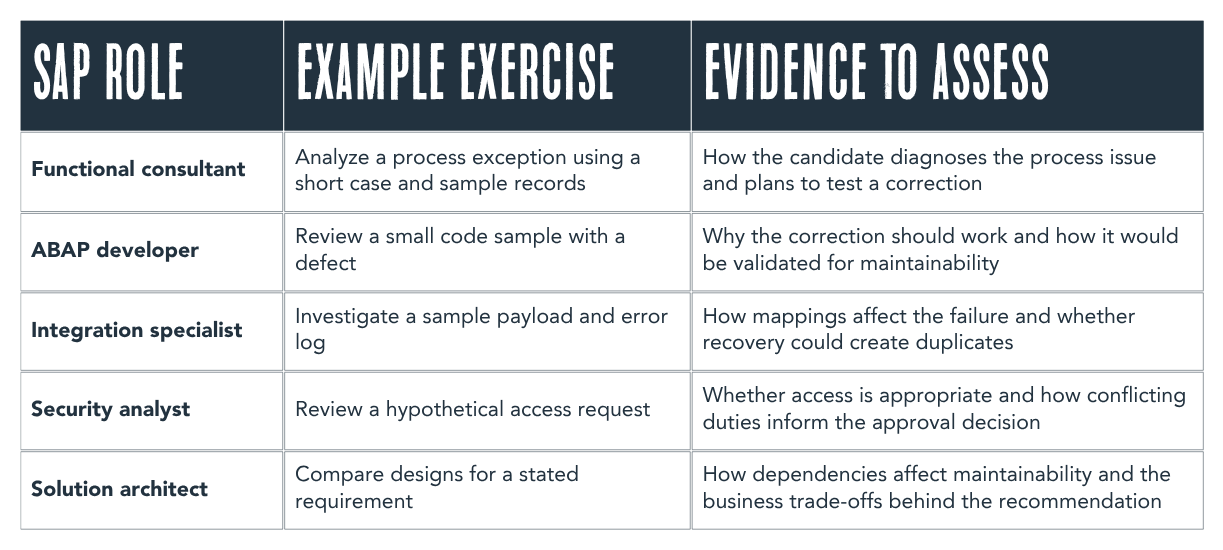
SAP’s own approach to validating skills has evolved in this direction. In its September 2026 certification update, SAP described practical, performance-based assessments involving real challenges in SAP systems. As Diana Roesner, SAP’s head of certification transformation, explained, the shift involves “moving beyond what someone knows to validating what they can actually do.”
Certification can inform the conversation, but the interview should still establish whether a candidate’s capabilities match your environment and responsibilities.
Investigate Experience Through Specific Examples
A project decision or production issue the candidate personally handled can reveal how they work, particularly when they explain their responsibility in the context of the original problem. The discussion can then explore how they weighed alternatives and what outcome followed.
A statement such as “we implemented SAP S/4HANA” needs follow-up. Which process or component did the candidate own, and how did they respond when something went wrong? How did they confirm that their changes worked? Strong candidates can usually explain their contribution clearly while acknowledging other people’s work and the limits of their authority.
Candidates can explain those decisions without sharing confidential client information; an anonymized example can still demonstrate technical depth and judgment.
Use Consistent Scoring and Qualified Interviewers
A scorecard developed before interviews begin gives the hiring team a shared basis for evaluating candidates. Greenhouse’s scorecard guidance, updated in May 2026, describes reviewing candidates against predetermined criteria and assigning focus attributes to interviews. For SAP roles, the criteria should distinguish technical accuracy from the way a candidate investigates problems. Business understanding and testing discipline also need clear definitions, with communication evaluated against the demands of the role. Rating anchors based on observable behavior help interviewers apply those criteria consistently.
For example, a strong troubleshooting answer explains how evidence narrows the possible causes and what would demonstrate that a correction worked. An answer that jumps to a fix without checking assumptions offers less support for a positive assessment.
Use comparable core questions for candidates applying to the same role, and have interviewers record evidence independently before discussing recommendations. Including an interviewer with current expertise in the relevant SAP area helps the team assess technical depth in that context. Recruiters can coordinate the process and assess broader fit, while technical specialists evaluate solution quality and depth.
Make the Interview Clear and Proportionate
Candidates should know what the exercise involves and how long it should take, with clear guidance on which resources they may use. If documentation or AI tools are allowed, apply the same rules consistently.
Asking candidates to explain and validate tool-assisted output helps establish whether they understand the recommendation and can recognize errors or inappropriate assumptions.
Keep tasks connected to the role and proportionate to the hiring decision. A focused exercise with useful follow-up can reveal more than a lengthy assignment that candidates complete with little context.
Time for candidates to ask about the SAP landscape and business priorities also gives them room to explore how the team is structured and who holds decision authority. Their questions can reveal how they evaluate the work they’d be joining.
FINAL THOUGHTS
An effective technical interview for SAP roles connects technical knowledge to the decisions and problems the person will encounter on the job. Realistic scenarios and focused exercises give hiring teams evidence they can evaluate through consistent scoring.
Agreeing on the role’s essential responsibilities gives the interview a clear focus, while relevant experts can help assess and document the evidence against those requirements. Feedback from new hires can then inform refinements when interview performance doesn’t match the demands of the job.
The strongest hiring decisions come from understanding how candidates investigate and validate their choices. That evidence helps organizations select SAP professionals who can contribute confidently to both the technology and the business processes it supports.