
Are SAP Team Skills Gaps Driving You to Hire More People?
- November 10, 2026
A growing SAP backlog can make hiring seem like the obvious response, particularly when difficult issues keep pulling the same senior consultant away from planned work. If testing is slipping too, the pressure to add someone grows—but what should that person actually do?
Another functional consultant might increase configuration capacity. An integration specialist could resolve a dependency blocking several workstreams, while a test lead might bring structure to work that currently looks like a staffing shortage. Understanding the cause helps leaders choose the support that will make a difference.
KEY TAKEAWAYS
- Distinguish missing expertise from insufficient capacity before adding headcount.
- Investigate blocked work to identify dependencies and decision delays.
- Match available skills to upcoming project responsibilities.
- Build backup expertise where delivery depends on one specialist.
- Choose a response that fits the gap’s urgency and duration.
High workloads may reflect insufficient capacity or missing expertise, but unclear requirements and slow decisions can also consume capable people’s time. In SAPinsider’s March 2026 Technology Leader’s Strategic Agenda report, 70% of respondents identified increasing operational efficiency and reducing costs as their top business priority. A staffing request should therefore explain how the investment will improve delivery.
UNDERSTANDING SAP TEAM SKILLS GAPS
Separate Capacity Gaps from Skills Gaps
A capacity gap exists when people know how to complete the work but lack enough time, whereas a skills gap exists when a required task needs expertise the available team cannot confidently provide. Both can occur together.
These patterns offer starting points for investigation; evidence from the work should determine the response.
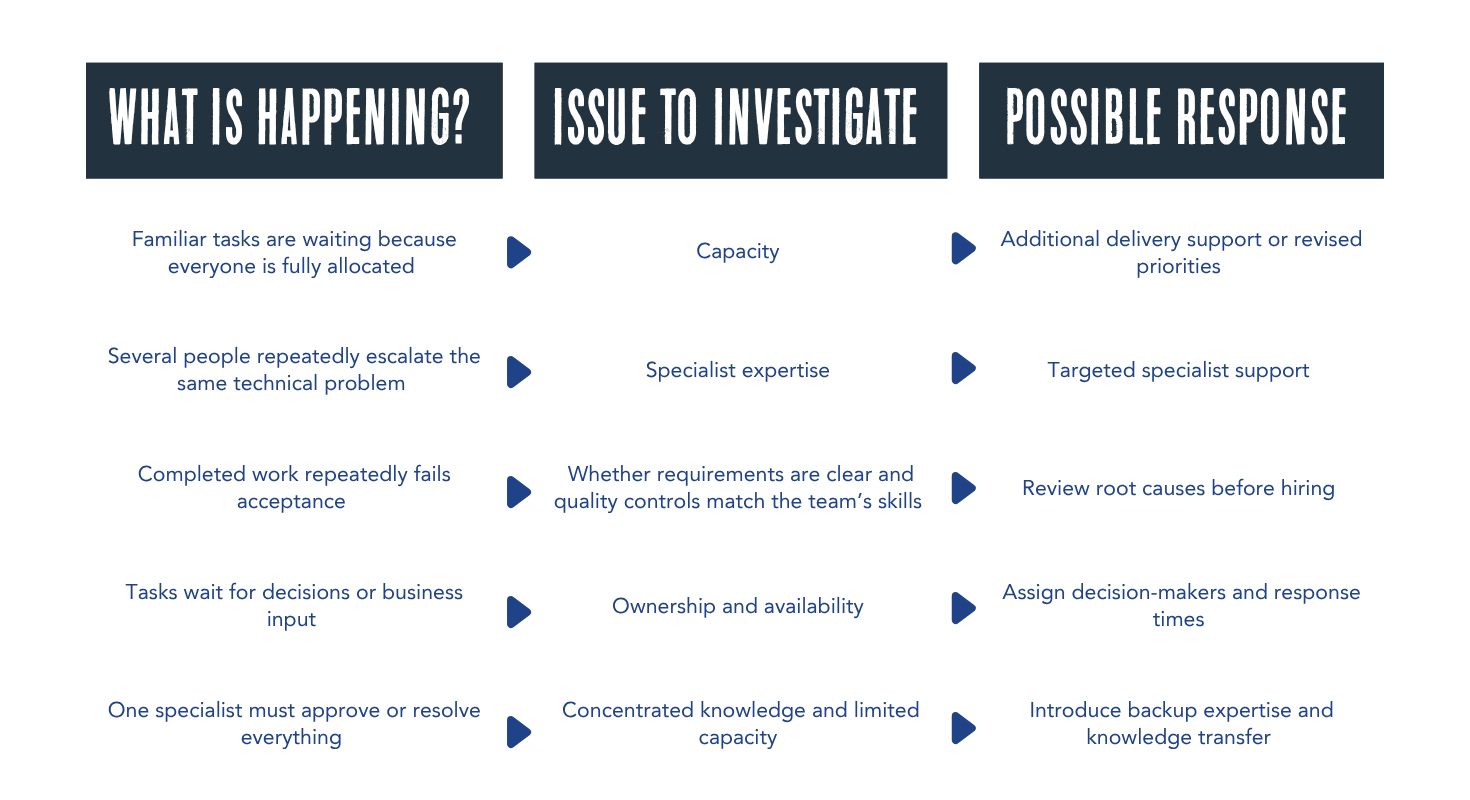
Examine Blocked Work Before Counting Open Tickets
A backlog total shows how much work is recorded, but understanding why it remains unfinished requires reviewing a representative sample of delayed tasks and defects. For each item, you should establish:
- What is preventing the next step?
- Who has the knowledge to resolve it?
- How much active work remains?
- How long has it been waiting for input or approval?
- Has the same issue occurred before?
For example, ten defects waiting for one interface fix may need targeted integration support before additional delivery capacity becomes useful. Repeated reconciliation failures may similarly require someone to clarify data mappings and ownership before the team can validate results reliably.
Check Whether Your Skills Match the Next Project Phase
The skills a team needs change as a project progresses. Design may depend on workshop leadership and process judgment, while testing requires defect diagnosis and cross-functional coordination. As cutover approaches, dependency management and clear escalation become important.
Mapping upcoming deliverables against available expertise helps identify gaps before the next phase, including where business participation is needed. A technically complete solution can still wait for process decisions or business acceptance, with test execution also dependent on people’s availability.
Identify Where Expertise Is Too Concentrated
Even a team with the right skills can face bottlenecks when one person understands critical pricing logic or is the only consultant who can safely reprocess failed interfaces. Those responsibilities compete with planned project work, creating a dependency that becomes harder to manage during competing deadlines or turnover.
Reviewing who can perform critical work independently helps identify where backup expertise is needed. Documentation and practical knowledge transfer can prepare another person to provide cover, while additional junior capacity may help with routine tasks. The plan also needs to address specialist decisions that remain concentrated.
Match the Response to the Gap
Once the gap is clear, choose a response that fits its urgency and duration.
Hire permanently when the capability will be needed regularly and forms part of the organization’s ongoing SAP responsibilities.
Bring in a specialist for an urgent or narrowly defined requirement, including support tied to a project milestone.
Develop existing staff when relevant foundational skills exist, and the delivery schedule allows time for supervised practice.
Clarify ownership and handovers when work waits on decisions, and remove approval steps that don’t serve a clear purpose.
These responses can be combined. A specialist might resolve an immediate issue while coaching an internal colleague to support the solution afterward.
BUILDING THE SAP TEAM YOUR WORK REQUIRES
Growing your SAP team may be the right decision, but its value depends on understanding what the additional resource needs to contribute.
Assessing SAP team skills gaps helps distinguish a need for delivery capacity from a need for specialist expertise, while revealing where ownership or workflow changes could unblock existing staff. Before approving your next SAP vacancy, identify the work it should move forward and whether hiring is the most useful response.